Tariffs Do Not a Sanction Make: IEEPA, Congress, and the Limits of Executive Power
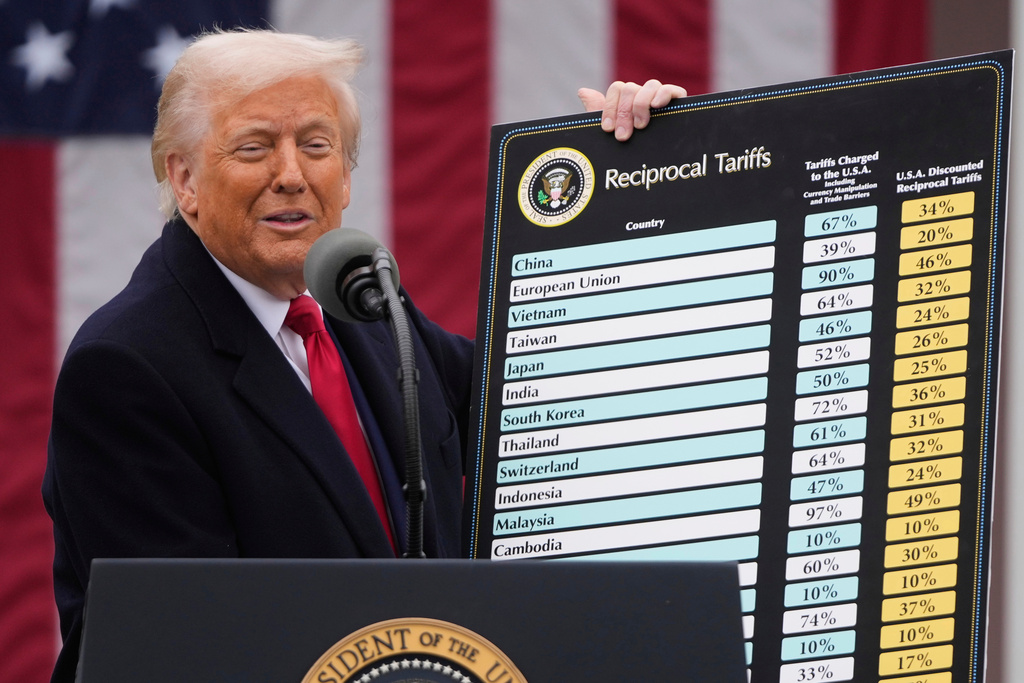
President Donald Trump speaks during an event to announce new tariffs in the Rose Garden at the White House, on April 2, 2025, in Washington. (AP Photo/Mark Schiefelbein)
Few powers are more jealously guarded by the Constitution than the power to tax, and for good reason. The Framers vested the taxing and foreign-commerce powers in Congress, even requiring revenue measures to originate in the House.1 That design is not some quaint relic. It embodies the basic proposition that imposing broad burdens on the people’s pocketbooks should be done by the people’s representatives. The recent litigation over President Trump’s “reciprocal” and “trafficking” tariffs, imposed by executive order under the International Emergency Economic Powers Act,2 tests whether this architecture still has force. The Court of International Trade (CIT) said the tariffs were unlawful.3 The Federal Circuit, sitting en banc, affirmed.4 They were right, and not necessarily because courts are hostile to energetic executive action, but because the statute Congress wrote does not grant what the Executive claimed, and reading it to do so would invite constitutional trouble of the first order.5
IEEPA’s Text and Limits
The 1977 International Emergency Economic Powers Act (IEEPA) authorizes the President to act after declaring a national emergency. The emergency must concern an “unusual and extraordinary threat” that originates in whole or substantial part outside the United States, at which point the President may “investigate, regulate, or prohibit” certain economic dealings and block or “nullify” property interests tied to foreign states or nationals.6 In short, IEEPA is a sanctions toolkit. Its operative verbs are “investigate,” “regulate,” “prohibit,” and “block,” and they attach to classic sanctions objects: transfers of property, transactions involving foreign nationals, and currency or securities flows.7 Instead, tariffs, duties, and imposts are nowhere to be found.
Then, some might say the word “regulate” is broad enough to cover tariffs, but context hides its meaning. Here, “regulate” is found alongside verbs like “prohibit” and “block,” applied to financial and property transactions. That is again the idiom of sanctions, not taxation. And when Congress wants the President to wield tariff authority, it says so expressly. Section 232 of the Trade Expansion Act allows the President to “adjust” imports, including tariffs or fees as methods of adjustment, but only after an investigation and a determination that imports of a specific “article” threaten national security, based on statutory criteria.8 The safeguards provisions follow a similar pattern: they require findings of serious injury and impose time limits. Section 301 likewise requires the US Trade Representative to make formal determinations before any retaliatory measures may be taken.9 Currently, no such investigation has taken place.10
IEEPA lacks the architecture because it serves a different function: targeted sanctions to cut off the fuel of genuine foreign-sourced emergencies, not some shadow revenue code to rewrite tariff schedules by proclamation.
Tariffs are not embargoes. An embargo under IEEPA prohibits specific goods from entering commerce altogether: a targeted, binary measure tethered to a threat. Tariffs are not prohibitions. They are taxes imposed across lawful commerce, raising revenue and altering price signals for all imports in a category. The difference is not semantic, embargoes sever the link to the foreign threat, while tariffs tax Americans in the hope of indirect leverage. The former fits IEEPA’s sanctions logic, while the latter intrudes into Congress’s taxing domain.
Two textual features of IEEPA confirm the point. First, the statute’s threshold is high by design. A President may act only upon an “unusual and extraordinary threat” that is foreign in origin or at least in substantial part.11 “Unusual” signals rarity while “extraordinary” signals severity and urgency. For nearly five decades, the Executive has invoked IEEPA when those words mean what they say: freezing the assets of allegedly hostile regimes and officials; blocking transactions with designated terrorists and proliferators; embargoing classes of goods linked to war or civil conflict; and sanctioning egregious human-rights violators. Those canonical uses are specific and concrete, not generalized macroeconomic grievances. Attempting to rebrand chronic trade deficits – which ebb and flow with global savings, exchange rates, and domestic consumption – as an “extraordinary” foreign threat thoroughly collapses the gatekeeping function of the predicate. The same skepticism applies to sweeping “trafficking” tariffs on consumer and industrial goods. At best, these tariffs are an indirect and attenuated response to illicit opioids. The Controlled Substances Act and targeted sanctions already address trafficking directly, and (to my knowledge) the government does not “deal with” fentanyl by taxing refrigerators.12
That brings us to IEEPA’s operative nexus. The statute authorizes actions “to deal with” the declared emergency.13 Words matter, of course. In the sanctions context, “deal with” refers to measures that directly constrain the threat’s locus. When the Office of Foreign Assets Control blocks a wire, the dollars do not move. If Commerce denies a license, the centrifuge parts do not ship. When the President prohibits particular dealings, US persons are legally out of that market. Broad, indefinite tariffs function differently. They do not target a malign actor, asset, or commodity, nor do they operate through blocking, licensing, or designation procedures that tether measures to particular actors or assets. Instead, they raise prices across lawful commerce, taxing US importers and consumers in the hope of inducing unrelated foreign policy change. Courts do not accept maximalist bargaining as a substitute for statutory text. This is diplomacy by taxation. It may be an instrument of leverage, but within IEEPA’s logic, it is not a measure that “deals with” the emergency itself. If such leverage qualifies, nearly any foreign-tinged grievance can be laundered through IEEPA, and the statute’s limiting language becomes a polite suggestion. Courts resist readings that convert exceptions into the rule or that convert specific toolkits into general warrants.14 The imposition of tariffs is not a decision the Executive may undertake unilaterally; it belongs to Congress, which may delegate only within the limits it prescribes.
Context, Tariffs, and the Major Questions Doctrine
The statutory neighborhood confirms what the text already suggests. When Congress delegates potent tariff tools, it routinely builds discipline into the grant: a defined trigger requiring investigation and concrete findings about identified “articles” or industry injury; an articulated purpose and factors to channel discretion, guardrails and time limits; and an outer ceiling keyed to necessity. Section 232 is the model, and the Supreme Court’s holding in Algonquin rests on precisely those limits.15 The safeguards regime and Section 301 follow similar patterns in their domains. It takes only a glance at IEEPA to see that Congress put the tariff-delegation machinery elsewhere. That comparison, effectively, does two kinds of work. As a matter of interpretive common sense, this sidesteps the elephant-in-mouseholes problem. Congress does not smuggle a sweeping tax power into vague catch-alls when it knows perfectly well how to speak with specificity.16 Put differently, if Congress wanted to hand the President a new taxing authority, it would have said so. Constitutional structure respects lines drawn for good reasons: sanctions belong in sanctions statutes, tariffs in tariff statutes.
Even if both the textual and contextual cases were closer than they are, the major-questions doctrine would block the Executive’s theory. When the Executive claims to discover in a long-extant, general statute an authority of “vast economic and political significance,” courts require a clear statement from Congress.17 Few powers are more “major” than reengineering import duties at scale. Tariffs of the magnitude at issue reorder supply chains, prices, and diplomatic posture, and they raise hundreds of billions of dollars from American importers and consumers. Again, IEEPA does not mention tariffs. It has never been used for them in nearly half a century, and no court has accepted IEEPA as a general tariff power, especially since the en banc Federal Circuit recently rejected that very theory.18 Congress has reserved tariff tools to bespoke statutes that contain explicit ceilings and procedures. Under West Virginia v. EPA, general sanctions language cannot be repurposed into a de facto tax license. Nor is the doctrine confined to agencies. Its premise is interpretive: when Congress delegates power of vast economic and political significance, it must do so clearly. It makes no difference whether the delegatee is an independent agency or the President. What matters, specifically here, is that Congress did not speak in unmistakable terms. If anything, claiming an open-ended taxing authority makes the clear-statement rule more pressing because it trenches on Article I’s core. If Congress means to arm the President with that power, it must say so unmistakably. It has been said so elsewhere, and § 232 is Exhibit A. It did not say so here.
Some point to United States v. Yoshida International, Inc., decided under the Trading With the Enemy Act before IEEPA’s enactment, to suggest that monetary surcharges are part of the executive’s emergency toolkit.19 The analogy does not hold. TWEA’s peacetime sprawl is the very problem Congress corrected by passing IEEPA in 1977 and restricting TWEA’s economic powers to times of war. Yoshida involved a narrow, temporary surcharge tied to a concrete balance-of-payments emergency amid a specific statutory and diplomatic backdrop, not some roving, economy-wide rewrite of the tariff schedule. By contrast, the Supreme Court’s Algonquin decision sustained monetary exactions under § 232 because Congress supplied an intelligible principle: a finding that imports of an identified “article” threaten national security, factors to guide judgment, and a necessity ceiling. Algonquin is a template for how Congress delegates tariff power without violating the nondelegation doctrine, not a springboard for discovering such power in statutes that never mention it.20
Nondelegation and the Separation of Powers in Tariff Authority
The constitutional backdrop disciplines how courts read IEEPA without inviting serious nondelegation concerns. Reading IEEPA to authorize open-ended tariffs would press the nondelegation doctrine to the breaking point. Congress cannot transfer legislative power to the Executive without an intelligible principle, and the more fundamental the power, the more demanding the principle should be.21 Tariffs are taxes, and taxes are the lifeblood of the government. To be sure, tariffs also regulate foreign commerce, but that dual character heightens, rather than relaxes, the need for congressional clarity. When Congress intends executive tariff adjustments for regulatory ends, it uses bespoke trade statutes with standards and ceilings; § 232 is the model. The Constitution further subjects taxation to democratic discipline by placing it in Article I and by requiring the House to originate revenue bills. The Court has upheld tariff delegations when Congress supplied real limits, as Algonquin illustrates. Although nondelegation has not been a scythe in modern times, several Justices have signaled an appetite to revive it when the Executive asserts sweeping, standardless authority.22 It is quite unnecessary to rely directly on nondelegation here because the avoidance canon steers courts toward fair readings to avert significant constitutional concerns.23 A faithful reading of IEEPA does that work neatly: it authorizes targeted sanctions that “deal with” genuine foreign emergencies, but it does not silently relocate a core taxing power to Article II.
Foreign-affairs exceptionalism does not at all change the analysis. Curtiss-Wright’s “sole organ” rhetoric about the President in external relations is often invoked for broad readings and thin review.24 Granted, courts have often stressed that the political branches deserve latitude in matters of foreign commerce and national security. But latitude is not a license. Even in foreign affairs disputes, the Court has drawn lines. In Hamdan v. Rumsfeld, it declined to read general statutes as a blank check for military commissions. And then in Medellín v. Texas, it told the President he could not transform an international judgment into domestic law by sheer say-so.25 Foreign-affairs deference is not a magical license to ignore the text. Curtiss-Wright upheld a narrow arms-embargo delegation keyed to a specific conflict and backed by presidential findings. It did not hold that the President is free of Congress’s checks whenever foreign affairs are implicated. The Court has been careful on this score. In Zivotofsky v. Kerry, while recognizing an exclusive presidential power over recognition of foreign sovereigns, the Court insisted that “the Executive is not free from the ordinary controls and checks of Congress merely because foreign affairs are at issue.”26 Tariffs and trade belong textually to Congress. Labeling a policy “foreign” does not teleport it to Article II. If anything, Youngstown points squarely against the Executive here. Justice Jackson explained that “when the President takes measures incompatible with the express or implied will of Congress, his power is at its lowest ebb,” and that claims to such power “must be scrutinized with caution, for what is at stake is the equilibrium established by our constitutional system.”27 A statute that says nothing about tariffs cannot, by any stretch, become the statutory authority of sweeping tariffs. The claim thus falls into Category Three, where presidential assertion must yield to statute.
Deference cannot arbitrarily convert statutory silence into authority. Although courts owe respect to the political branches in foreign affairs, determining whether a statute’s predicates are satisfied and whether the means match the ends is a legal task, not a diplomatic one (Zivotofsky).28 The Executive does not gain power by invocation. With Loper Bright displacing Chevron, courts apply independent judgment on questions of law. Now, the major-questions doctrine constrains claims of vast economic or political significance, and nondelegation stands as a kind of backstop. Still, not one of these doctrines permits the Executive to extract a tariff power from general sanctions language. Each underscores the same rule: when the Executive claims a transformative domestic authority, especially the power to tax, Congress must speak clearly.29
Judicial Review and the Path of Remedies
Remedy and review deserve brief attention, because the courts’ restraint on these points underscores rather than weakens the statutory holding. The CIT granted summary judgment and entered a permanent injunction against enforcement of the tariffs. The Federal Circuit stayed the injunction, then vacated it and remanded. In a separate order, the court withheld its mandate through October 14.30 That remedial posture reflected a judgment that relief had to be uniform in order to avoid abrupt market shocks and inconsistent administration of customs. A declaratory judgment would have clarified the law without coercion, but here the court went further, issuing a permanent injunction that barred enforcement against all importers. And given this Court’s contested history with universal injunctions, the choice was fairly telling. Debate persists over whether nationwide injunctions are overused, but tariffs present a unique administrability problem: a partial injunction advantages some importers over others and invites duplicative litigation, whereas a uniform remedy avoids arbitrage and confusion. The Federal Circuit’s decision to withhold its mandate briefly to permit Supreme Court review was an institutional nod to the economic consequences of abrupt tariff changes, not a signal of doubt about the merits. Whatever the final shape of relief, the crucial point remains: unlawfully imposed duties may not be collected.31
Some have suggested that the en banc court’s fragmented opinions muddle the holding. They do not. The bottom line is straightforward: a majority of the Federal Circuit agreed that these tariffs exceeded any authority IEEPA confers. In circumstances where no single rationale commands a majority, the Supreme Court’s Marks rule directs lower courts to identify the narrowest grounds supporting the judgment.32 Here, one opinion would have held categorically that IEEPA never authorizes tariffs. Then, by contrast, another invalidated the tariffs by emphasizing IEEPA’s emergency predicate, the “deal with” nexus, and the mismatch between the statute’s sanctions design and the Executive’s across-the-board duties. That latter rationale is narrower and thus controlling: under IEEPA, the President cannot impose blanket, indefinite, economy-wide tariffs in the name of a generalized policy grievance masquerading as an “extraordinary” emergency. Whether some narrow exaction, closely tethered to the direct interdiction of a real foreign-sourced crisis, could ever fit IEEPA’s text is a question left for the case that will inevitably present it. The controlling rule does not require answering that hypothetical to dispose of the tariffs at hand.
The remaining counterarguments are familiar, and they fail for familiar reasons. One argument is that to “regulate importation” is to impose tariffs. Sometimes yes; often no. Context cabins language. In IEEPA, “regulate” appears alongside currency and securities, property and transfers, and blocking and prohibitions. It is the idiom of sanctions, not taxation.33 Another claim is that foreign affairs discretion should fill statutory gaps. Showing deference is not the same as granting the Executive a pen to write statutes. Zivotofsky and Youngstown make clear that the President is not a legislator even when the subject is foreign. A further claim is that emergencies demand flexibility. They do – and Congress has provided it. IEEPA’s sanctions tools are potent; § 232 and § 301 allow time-limited, fact-bound tariff adjustments upon investigation and findings.34 Assumed flexibility does not make an Article I power.
The decision has positive practical effects. It preserves a robust sanctions toolkit, allowing the President to freeze assets, bar transactions, and embargo particular goods in response to genuine “unusual and extraordinary” foreign threats.35 At the same time, it reinforces the constitutional order of trade governance by rejecting any repurposing of a sanctions statute into a general tariff code absent the architecture and clarity Congress uses when it means to legislate tariffs. Importantly, although the tariffs have been ruled unlawful, they remain in effect as of August 30, 2025, under the court of appeals’ stay, which runs until October 14 to allow the administration to seek Supreme Court review.36
However, at that point, the administration has to face the hurdles of appropriations law. Congress’s fiscal commands are binding: once funds are appropriated for a stated purpose, the Executive must obligate it consistent with the Purpose Statute and the Anti-Deficiency Act.37 The Impoundment Control Act permits only narrow, time-limited deferrals and requires congressional approval for rescissions.38 Train v. City of New York confirms that an agency may not refuse to spend to defeat the statute it administers, while Lincoln v. Vigil recognizes discretion only within genuine lump-sum appropriations. Using IEEPA to raise general revenue and then to ration appropriations would collide with those limits.39
The rule of law here is thankfully not timid. It operates through the constitutional framework that the Framers designed. If a President wants to revolutionize tariff policy, there are two honest paths. He can persuade Congress to enact it. Or he can proceed under statutes that plainly authorize tariff tools and confine discretion with intelligible principles, temporal limits, and reviewable findings. IEEPA is not such a statute. Its text targets sanctions for a real, foreign-sourced, “unusual and extraordinary” threat, and its measures must “deal with” that threat directly. The statute gives no hidden power to tax imports whenever leverage seems useful, much less a tool of political grandstanding. Insisting on that reading is fidelity to text and structure, and to the modest proposition that the power to tax is not buried in a sanctions law. If Congress wishes to arm the President with broader tariff tools, it may do so overtly, with standards and limits. Until then, emergencies use emergency tools, tariffs use the trade laws, or Congress changes them. That is how a republic governs itself.
- U.S. Const. art. I, § 8; U.S. Const. art. I, § 7, cl. 1. ↩︎
- Exec. Order No. 14193, 90 Fed. Reg. 9,113 (Feb. 1, 2025); Exec. Order No. 14194, 90 Fed. Reg. 9,117 (Feb. 1, 2025); Exec. Order No. 14195, 90 Fed. Reg. 9,121 (Feb. 1, 2025); Exec. Order No. 14257, 90 Fed. Reg. 15,041 (Apr. 7, 2025); Exec. Order No. 14266, 90 Fed. Reg. 15,626 (Apr. 9, 2025). ↩︎
- V.O.S. Selections, Inc. v. United States, Slip Op. 25-66, at 47–48 (Ct. Int’l Trade May 28, 2025). ↩︎
- V.O.S. Selections, Inc. v. Trump, No. 25-1812, slip op. at 43–45 (Fed. Cir. Aug. 29, 2025) (en banc). ↩︎
- West Virginia v. EPA, 597 U.S. ___, 142 S. Ct. 2587 (2022); International Emergency Economic Powers Act (IEEPA), 50 U.S.C. §§ 1701–1702 (2022).
↩︎ - 50 U.S.C. §§ 1701(a), 1702(a)(1) (2022). ↩︎
- 50 U.S.C. § 1702(a)(1)(A)–(B) (2022). ↩︎
- Trade Expansion Act of 1962 § 232, 19 U.S.C. § 1862(b)–(d) (2022); Fed. Energy Admin. v. Algonquin SNG, Inc., 426 U.S. 548, 559–60 (1976).
↩︎ - Trade Act of 1974 §§ 201–204, 19 U.S.C. §§ 2251–2254 (2022); id. § 301, 19 U.S.C. § 2411 (2022). ↩︎
- V.O.S. Selections, Inc. v. Trump, No. 25-1812, slip op. at 8–12 (Fed. Cir. Aug. 29, 2025) (en banc) (describing reliance on IEEPA rather than § 232/§ 201/§ 301 procedures). ↩︎
- 50 U.S.C. § 1701(a) (2022). ↩︎
- Controlled Substances Act, 21 U.S.C. §§ 801–971 (2022); 50 U.S.C. § 1702(a)(1) (2022). ↩︎
- 50 U.S.C. § 1702(a)(1) (2022). ↩︎
- Util. Air Regul. Grp. v. EPA, 573 U.S. 302, 324–25 (2014). ↩︎
- 19 U.S.C. § 1862 (2022); Fed. Energy Admin. v. Algonquin SNG, Inc., 426 U.S. 548, 559–60 (1976). ↩︎
- Whitman v. Am. Trucking Ass’ns, 531 U.S. 457, 468 (2001). ↩︎
- West Virginia v. EPA, 597 U.S. ___, 142 S. Ct. 2587 (2022); FDA v. Brown & Williamson Tobacco Corp., 529 U.S. 120, 159–61 (2000). ↩︎
- V.O.S. Selections, Inc. v. Trump, No. 25-1812, slip op. at 2–3, 43–45 (Fed. Cir. Aug. 29, 2025) (en banc). ↩︎
- United States v. Yoshida Int’l, Inc., 526 F.2d 560 (C.C.P.A. 1975).
↩︎ - Algonquin, 426 U.S. at 559–70.
↩︎ - J.W. Hampton, Jr., & Co. v. United States, 276 U.S. 394, 409–11 (1928). ↩︎
- Gundy v. United States, 588 U.S. 128, 139 S. Ct. 2116, 2141–48 (2019) (Gorsuch, J., dissenting). ↩︎
- Jennings v. Rodriguez, 583 U.S. 281, 314 (2018). ↩︎
- United States v. Curtiss-Wright Exp. Corp., 299 U.S. 304, 319–22 (1936).
↩︎ - Hamdan v. Rumsfeld, 548 U.S. 557 (2006); Medellín v. Texas, 552 U.S. 491 (2008). ↩︎
- Zivotofsky v. Kerry, 576 U.S. 1, 21 (2015). ↩︎
- Youngstown Sheet & Tube Co. v. Sawyer, 343 U.S. 579, 635–38 (1952) (Jackson, J., concurring). ↩︎
- Zivotofsky, 576 U.S. at 21. ↩︎
- Loper Bright Enters. v. Raimondo, 603 U.S. ___, 144 S. Ct. 2244 (2024); Relentless, Inc. v. Dep’t of Com., 603 U.S. ___, 144 S. Ct. 2256 (2024).
↩︎ - V.O.S. Selections, Inc. v. United States, Slip Op. 25-66 (CIT May 28, 2025); Order, V.O.S. Selections, Inc. v. Trump, No. 25-1812 (Fed. Cir. May 29, 2025) (administrative stay); Order, V.O.S. Selections, Inc. v. Trump, No. 25-1812, at 2 (Fed. Cir. Aug. 29, 2025) (withholding mandate through Oct. 14, 2025).
↩︎ - DHS v. New York, 589 U.S. ___ (2020) (Gorsuch, J., concurring in the grant of stay). ↩︎
- Marks v. United States, 430 U.S. 188, 193 (1977). ↩︎
- 50 U.S.C. § 1702(a)(1)(A)–(B) (2022). ↩︎
- 19 U.S.C. § 1862; 19 U.S.C. §§ 2251–2254; 19 U.S.C. § 2411 (2022). ↩︎
- 50 U.S.C. § 1702(a)(1) (2022). ↩︎
- Order, V.O.S. Selections, Inc. v. Trump, No. 25-1812, at 2 (Fed. Cir. Aug. 29, 2025) (mandate withheld through Oct. 14, 2025).
↩︎ - Purpose Statute, 31 U.S.C. § 1301(a) (2022); Anti-Deficiency Act, 31 U.S.C. § 1341 (2022); Apportionment, 31 U.S.C. § 1512 (2022). ↩︎
- Impoundment Control Act of 1974, 2 U.S.C. §§ 681–688 (2022); U.S. Gov’t Accountability Off., B-331564, Office of Mgmt. & Budget—Withholding of Ukraine Security Assistance 1 (Jan. 16, 2020).
↩︎ - Train v. City of New York, 420 U.S. 35 (1975); Lincoln v. Vigil, 508 U.S. 182 (1993). ↩︎
This piece has been edited by Ivy Jiang and Abby Ferraro.

Vladimir Gaberman is a junior at NYU, where he studies economic theory and international relations. His writing explores the intersection of monetary and fiscal policy, national security, and American jurisprudence. He previously worked at the Social Science Research Council for the Africa Peacebuilding Network, where he contributed to the program’s statistical analysis efforts. His independent work includes examining the fiscal and distributional impacts of energy subsidies in Nigeria and analyzing the structural drivers of U.S. infrastructure recovery in the post-COVID-19 economy. Beyond his academic work, he is an avid backpacker and nature enthusiast.