Despite a ceasefire, Israel’s strategic assault on aid continues
Israel’s deliberate encroachment upon humanitarian assistance jeopardizes the lives of Palestinians and the future of civilians in conflict
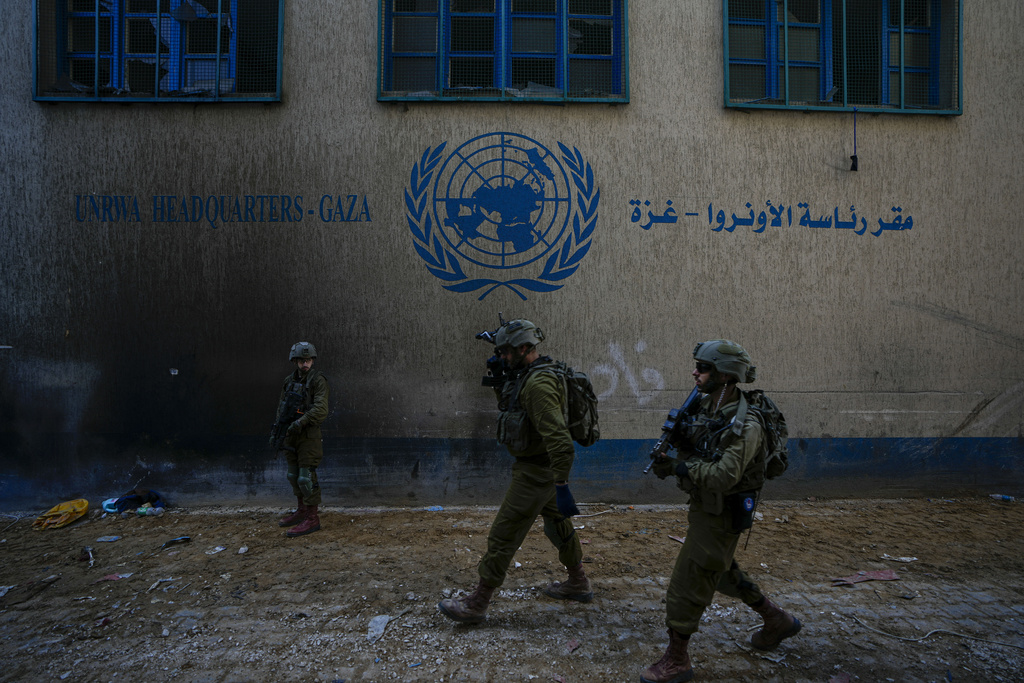
Israeli soldiers take position as they enter the UNRWA headquarter during a ground operation in Gaza, Feb. 8, 2024. (AP Photo/Ariel Schalit, File)
The humanitarian assistance trickling into Gaza cannot compensate for Israel’s ongoing ceasefire violations that continue to take Palestinian lives. Both are byproducts of the October 2025 ceasefire agreement under which elements of the war have persisted long after the guns were meant to fall silent. For Gaza’s residents sheltering in tents and in desperate need of clean water, food, shelter, and health care, the recovery has only just begun. Once-thriving neighborhoods lay flattened, littered with unexploded ordnance that continues to cause deaths as an omnipresent reminder of a brutal war. Israel’s response to these conditions has fallen far short of the commitment that the ceasefire agreement intended. Rather, its limited facilitation of aid has been just one aspect of a prolonged strategy to constrain the humanitarian system, erode its independence, and ultimately replace it to advance political and military objectives.
Neutrality under fire
Guided by the United Nations, that humanitarian system operates independently from combatants in order to support vulnerable civilians exposed to conflict. Together, the U.N. and non-governmental organisations (NGOs) deliver assistance impartially, based solely on need, regardless of one’s nationality, race, gender, religion, or political affiliation. In Gaza, that need is overwhelming. Yet throughout the war, and in the period since its supposed conclusion, the work of such organizations has been repeatedly suppressed. That such a conclusion exists is not evident for the reported 601 Palestinians killed since the ceasefire was signed, nor the NGOs struggling to alleviate the suffering of those who survived. Dozens of such organizations now face expulsion from Gaza for refusing to commit to invasive Israeli-mandated registration requirements that impede basic concepts of international law and the safety of Palestinian civilians.

Obstruction of humanitarian efforts has been a theme throughout the war. A clear strategy saw Israel preventing aid convoys from entering the Strip, causing widespread food insecurity and shortages of critical medical supplies. This was compounded by an attempt to supplant established NGOs through the creation of a securitized aid contractor, the Gaza Humanitarian Foundation, whose disregard for basic humanitarian processes contributed to preventable deaths. Direct attacks by the Israel Defense Forces (IDF) on aid facilities and personnel further devastated the system, killing at least 500 humanitarian workers and more than 1,500 medical workers. The humanitarian system has rarely experienced such bloodshed. This dual strategy, combining institutional pressure with physical violence, undermines the autonomy of the humanitarian system, intimidates the NGOs that sustain it, and will carry profound consequences for civilians in future conflicts.
Deprivation born of grievance
Israel’s feud with the humanitarian system was born out of several issues. First, Israel regards that system, including international NGOs, as part of a U.N.-led infrastructure hostile to its interests, because it has, for decades, sought to hold Israel accountable for its conduct as an occupying power in the West Bank and for war crimes in Gaza and during earlier conflicts. These long-running tensions escalated when Prime Minister Benjamin Netanyahu accused U.N. local staff of participating in the Oct. 7, 2023, terror attack. Israel and the United States also claimed that Hamas had stolen U.S.-funded aid supplies during the war. These claims were largely unsubstantiated, however, and were used to justify depriving roughly two million Gazans of lawful lifesaving assistance.
The U.N. responded to the terrorism allegations against its staff with an investigation that could not verify Israel’s evidence but still resulted in the termination of nine staff members. Israeli officials later acknowledged they had no evidence supporting claims that aid was routinely stolen from the U.N. The U.S. also determined that there was “no evidence of systematic theft by… Hamas of U.S.-funded humanitarian supplies.” Regardless of the lack of validity in these claims, Israel continued to defy international pressure as it curbed basic goods and lifesaving services, further deteriorating already unlivable conditions in Gaza.

This restrictive access paved the way for multiple unnecessary innovations. In March 2024, the U.S. began conducting airdrops of critical food and other supplies following earlier operations by Jordan, Egypt, France, and the United Kingdom. Widely inefficient in their tonnage-to-effort ratio in comparison to convoys, many such drops landed in the sea and in designated combat zones, resulting in several Palestinian deaths. The same month, President Joe Biden announced the construction of a floating pier on Gaza’s Mediterranean coastline to facilitate the delivery of aid. Functional for just two months until heavy seas forced its discardment, the total assistance brought in by the $230 million pier amounted only to what Gaza required for a single day. These dramatic operations, normally reserved for remote locations, were unique in that they occurred in a territory with numerous existing land border points under near-total control of a close U.S. ally. The charade affirmed the Biden administration’s complete inability to exact from Israel any basic compliance with international humanitarian law despite the U.S.’s continued provision of billions of dollars in military and economic assistance to support the war.
The rise and fall of the Gaza Humanitarian Foundation
Still, the most creative affront to the humanitarian aid system was the Gaza Humanitarian Foundation (GHF). Established in February 2025 as an experiment to bypass the U.N.-led system, the GHF shattered any commitment to independence as it worked in lockstep with the IDF. Conceived by individuals close to the Israeli government who saw opportunity in Israel’s animosity toward the U.N., the private contractor received predominantly Israeli and American funding. Its ascent occurred during arguably the most desperate phase of the war for civilians, and basic logistical and operational concepts, well-established in the humanitarian sector, were entirely ignored. After breaking the January 2025 ceasefire arrangement, Israel implemented a 90-day total ban on trucks entering Gaza. As a result, from March to May 2025, mass starvation took hold. Almost a quarter of Gaza’s population of 2.1 million experienced “famine-like conditions” according to the World Food Programme. In this desperate hour, the fledgling GHF soon became responsible for half of the aid entering Gaza.
The consequences were disastrous. GHF demonstrated no capacity to conduct comprehensive food distribution. Equally alarming, in more than five months of operation from May to October 2025, 2,615 Palestinians were killed and over 18,000 injured at or near GHF distribution points as a result of shootings by the IDF or security contractors, as well as stampedes and explosions, according to the Gaza Health Ministry. GHF’s securitized distribution model was no accident but rather a product of design.

The company’s logistics were supported by heavily armed, novice security contractors. Their lack of experience in humanitarian assistance led one expert, James Wasserstrom, to suggest the contractors were “there for military purposes, more than feeding a starving population.” Officials from GHF defended their actions by claiming that Hamas intentionally provoked them. Available evidence, however, contradicted these statements and instead exposed GHF’s inhumane, heavily securitized distribution process. Chaos and disorder were commonplace as Palestinians seeking assistance queued in narrow, fenced-in corridors with barbed wire as armed contractors looked on.
The ineffectual operation disregarded decades of best practices formed through countless humanitarian interventions in conflict zones and famines. Moreover, GHF’s four distribution sites were located in areas controlled by the IDF, forcing civilians to travel through militarized areas to access aid. Three of those distribution sites were placed in the far south of Gaza near the Egyptian border. This fueled fears among Palestinians and many in the international community that GHF was helping the Israeli government forcibly relocate Palestinians out of Gaza, a strategic objective long desired by Israel’s far right. NGOs promptly spoke out against the chaotic tactics, and in July, more than 200 organizations issued an open letter calling for the closure of GHF and a return to the U.N.-led humanitarian system.


As it turned out, GHF needed the war to survive. With its distribution centers located on the IDF-occupied side of the Yellow Line that demarcated the October 2025 ceasefire, access for Palestinians was severed. In late November, GHF announced its closure, putting an end to a disastrous saga. For the impartial NGOs operating under the U.N.-led system, however, the ceasefire presented an urgent opportunity to get assistance to areas previously unreachable during conflict. Aid agencies rushed to provide care for those previously deprived, but it would not last long.
Administrative extortion
Israel informed 37 NGOs on Jan. 1, 2026, to suspend operations within 60 days for refusing to comply with the new registration requirements. The expulsion threat alarmed the international community, with the foreign ministers of the U.K., France, Japan, and seven other states calling the prospect of deregistration “unacceptable.” The U.N. and a collection of NGOs issued their own statement claiming that the new registration policy “relies on vague, arbitrary, and highly politicized criteria and imposes requirements that humanitarian organizations cannot meet without violating international legal obligations or compromising core humanitarian principles.” The conditions far surpass what is necessary to comply with local laws and regulations. NGOs warned that the new requirements would erode the independence of humanitarian operations, censor advocacy, and “further entrench Israeli control and de facto annexation of the occupied Palestinian territory.” Greatly exceeding administrative obligations, the registration requirements carry broader implications for the safety and rights of Palestinians.
Under the new policy, Israel reserves the right to revoke or deny the registration of NGOs that do not comply with its invasive terms. Many of the registration requirements are blatant censorship and infringe upon NGOs’ ability to report accurately on their assistance operations during conflict. Organizations may be disqualified for calling for accountability for war crimes, or if any of their staff or associated individuals support the boycott movement against Israel. Furthermore, information that is perceived as “delegitimization” of Israel can result in expulsion of the organization that produced it. Any NGO’s observations on the heavily-restricted operating environment or actions by the IDF could therefore be interpreted as delegitimization, creating an insecure space where truth is silenced.

As the NGOs described, “by framing humanitarian and human rights advocacy as a threat to the state, Israeli authorities can shut out organisations merely for speaking out about conditions they witness on the ground, forcing (international) NGOs to choose between delivering aid and promoting respect for the protections owed to affected people.” In another invasive measure, Israel mandated that NGOs share sensitive personal data of staff members for security vetting. Given a clear pattern of aid workers being targeted by the IDF during the war, NGOs remain deeply reluctant to provide any such information. In a context where the safety of humanitarians is already under constant pressure, providing transparent reporting would become effectively impossible.
Consequences of failure
By undermining the humanitarian system, Israel has revolutionized the way in which a combatant can manipulate aid as a weapon of war. Whether an agreement is reached by March 1, or the organizations are instead compelled to leave Gaza remains to be seen. Regardless, the aggressive restrictions that triggered the NGOs’ expulsion and the failures of Israel’s alternative model in the GHF must serve as a stark warning.
To preserve the integrity of the global humanitarian system and prevent Israel’s actions from becoming a template for future conflicts, policymakers in the U.S. and elsewhere must be conscious of the dangerous implications of the reckless response that they abetted. As President Donald Trump’s vision for Gaza has yet to prioritize those most in need, it is European and regional states that must hold Israel accountable for its actions. Moving forward, upholding the legal protections and safety of NGOs during conflict must go beyond rhetoric to protect the people they serve. Gaza today shows the cost of failing to do so.

Benjamin Larned is a second-year MA International Relations student at NYU concentrating in International Law. He received his BA in International Studies with a Minor in History from Old Dominion University. A career humanitarian, Benjamin has supported responses for the Rohingya refugee crisis, Syrian refugee crisis, post-ISIS reconstruction of Iraq, and the 2023-24 Israel-Hezbollah war in Lebanon. His areas of focus include humanitarian crises, US foreign policy, and the trans-Atlantic alliance.