What the Backlash Against Mamdani Reveals About Islamophobic Panic
Despite running on a progressive, inclusive agenda, Zohran Mamdani has been framed as a national threat, revealing how Islamophobia and immigrant identity are weaponized to suppress challenges to the political establishment.

Democratic mayoral candidate Zohran Mamdani takes selfies with supporters after speaking at his primary election party, Wednesday, June 25, 2025, in New York. (AP Photo/Heather Khalifa)
Zohran Mamdani’s stunning upset has sparked an intense wave of political outrage, from politicians predicting another 9/11 to referring to the candidate as a “terrorist Jihadist.” Blatant Islamophobic rhetoric, pushed by public officials themselves and amplified by mainstream media, is appalling. Indeed, Mamdani’s mayoral campaign has exposed the egregious hatred against Muslims that continues to linger in the United States, particularly concentrated amongst the very people who swear to uphold its constitutional principles of equality and religious freedom. And more importantly, it reveals the extent to which discrimination is normalized to discredit authentic campaigns.
Politicians and public figures have harnessed their utmost imagination in conjuring the epitome of a slippery slope fallacy. New York City councilwoman Vickie Paladino, for instance, has gone so far as to declare Mamdani a “known terrorist Jihadist.” By that logic, electing a Muslim mayor would send New York spiraling into a Jihadi state—just as the Twitter illustrations of a burkha-clad Statue of Liberty so helpfully predict. Jews, we’re told, will be forced to evacuate the city in light of an existential threat. As Trump Jr. recalls with overwhelming disappointment, we’ve regressed from enduring the horrific 9/11 attacks to directly “voting for it.” Besides, as New Representative and Trump’s one-time pick for UN ambassador, Elise Stefanik reminds us, Mamdani is a “Hamas sympathizer” and a “Muslim Maoist,” adds conservative activist Charlie Kirk. It’s not as if Mamdani repeatedly and unflinchingly condemned the Hamas attacks on October 7th, describing the event as a “horrific war crime.” Have we evolved so much, as critics, to refuse to use people’s own words against them?
“Mamdani has not only repeatedly acknowledged the rising crisis of antisemitism but also expressed unwavering commitment to combat such bigotry.”
If we critically examine the intent behind this highly controversial campaign, the democratic nominee has made it pretty clear what he wants. As Former New York Mayor Rudy Giuliani claims, Mamdani plans to “Destroy New York City”— particularly with city-owned grocery stores, free buses, free child care, and affordable housing. Furthermore, identifying with Islam translates to what Former National Security Adviser Michael Flynn calls “not a religion” but a “political ideology.” Such political ideology is reflected in Mamdani’s firm stance against Trump’s backlash on trans rights, his commitment to housing affordability, and his efforts to address employment challenges facing the LGBTQ+ community. And what about antisemitism? The candidate has not only repeatedly acknowledged the rising crisis of antisemitism but also expressed unwavering commitment to combat such bigotry. In fact, Mamdani plans to increase anti-hate crime funding by up to 800%. It’s no wonder the city’s highest-ranking Jewish official, Comptroller Brad Lander, not only cross-endorsed his campaign but also warmly embraced his supporters at the victory celebration.
Aside from flagrant Islamophobia, the president himself confidently pronounced Mamdani a “Communist Lunatic.” To put it succinctly, such outrage from those in power is a direct response to a candidate who is genuinely Democratic and Socialist. By advocating for wealth redistribution through taxing the rich, increasing public funding, implementing protective measures for immigrants and the LGBTQ+ community, and critiquing foreign policies, Mamdani directly challenges the administration. These positions provide ample grounds to frame the candidate as a threat to the current establishment. It’s therefore unsurprising that, despite being a lawful U.S citizen, Mamdani now faces threats of illegal deportation.
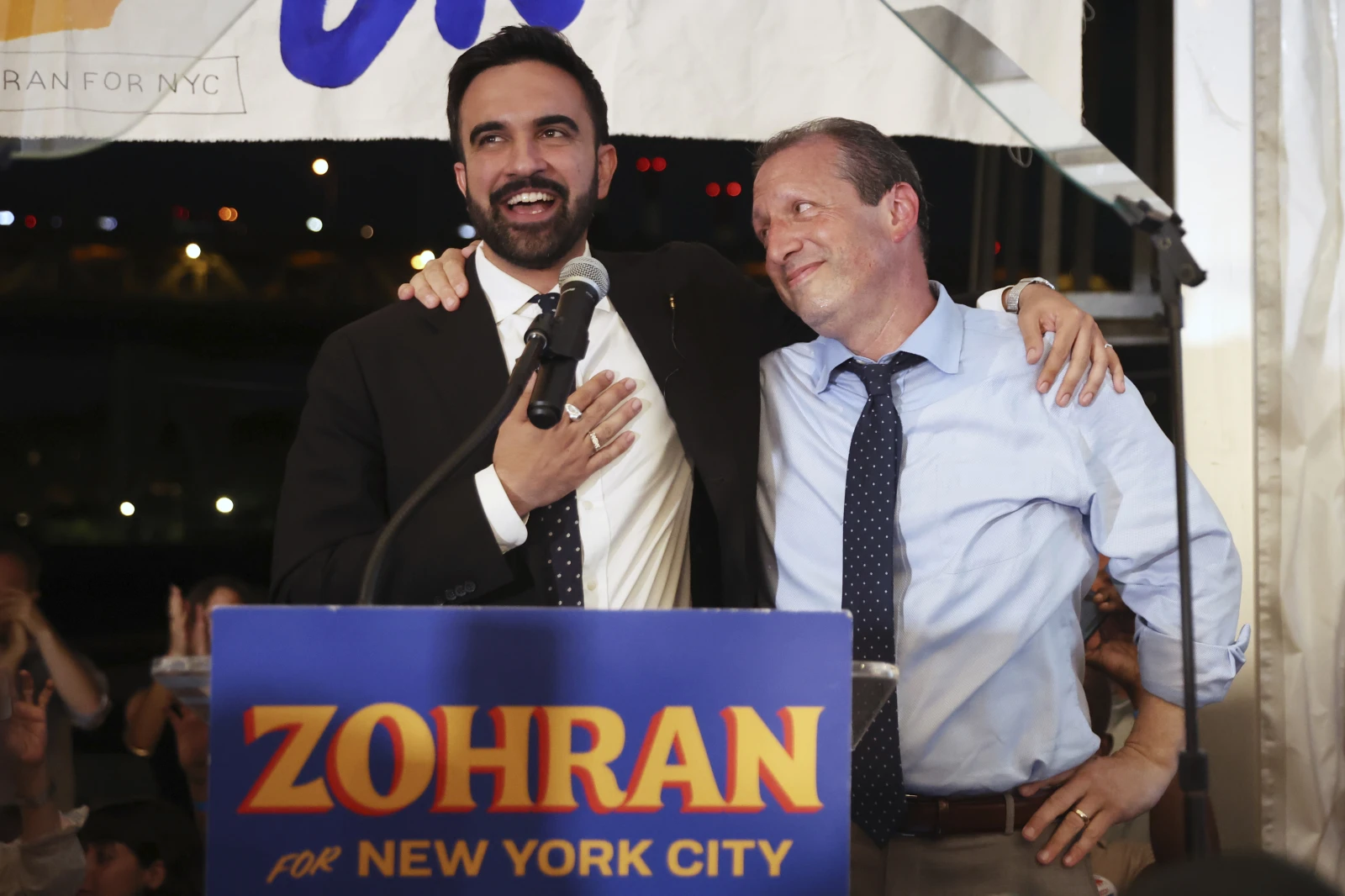
This is not to say that Mamdani’s economic or social platform should be wholly endorsed—critics unconditionally reserve the right to carefully examine and critique his policies. However, the accusations discussed are illogically far-fetched, not to mention mockable, as they entirely contradict his agenda. Moreover, criticisms, to put it generously, are not directed at his policies. Rather, they viciously attack his very identity as an immigrant Muslim. These extremist labels and bigotry are uncalled for; they leverage fear-mongering to undermine the legitimacy of candidates, particularly those who resist the existing order. Zohran Mamdani’s campaign didn’t just challenge the political establishment—it triggered its deep prejudices. It’s imperative to recognize the dire consequences of such prejudice. “I get messages that say, ‘The only good Muslim is a dead Muslim,’” Zohran Mamdani revealed to reporters, while referring to the sheer amount of abuse and death threats he had received since the beginning of his campaign. Such threats are not only emotionally scarring, but they also send a clear message to marginalized communities.
As Muslim immigrants, this is the normalized backlash we should expect if we take on dominant roles in the political sphere. That by launching a politically innovative campaign and winning, we should be belittled into the age-old box of perpetuating a terrorist agenda. Despite the policies we fight for, our identities will always be the first target.
This piece has been edited by Pau Torres Pagès and Julia Balis.

Taskeen Tauhid is an undergraduate Politics major with a minor in Journalism at New York University, where she focuses on public policy, governance, and political accountability. She is a Public Policy Intern at Citizens Union, where she researches New York City government ethics, campaign finance, and electoral reform, and contributes to policy analysis and public education initiatives. Previously, she worked as a Reproductive Rights Intern with the League of Women Voters of New York, where she researched state and local reproductive health laws, contributed to policy briefs on abortion and maternal healthcare access, and supported community outreach efforts during the mayoral election. Taskeen also serves as an Associate Editor for the Undergraduate Law Review, reviewing and fact-checking scholarly work on law and public policy, and as an Editor at NYU Zeitgeist, where she leads the editorial review of student commentary.