

The Status Quo Isn’t Giving Anymore
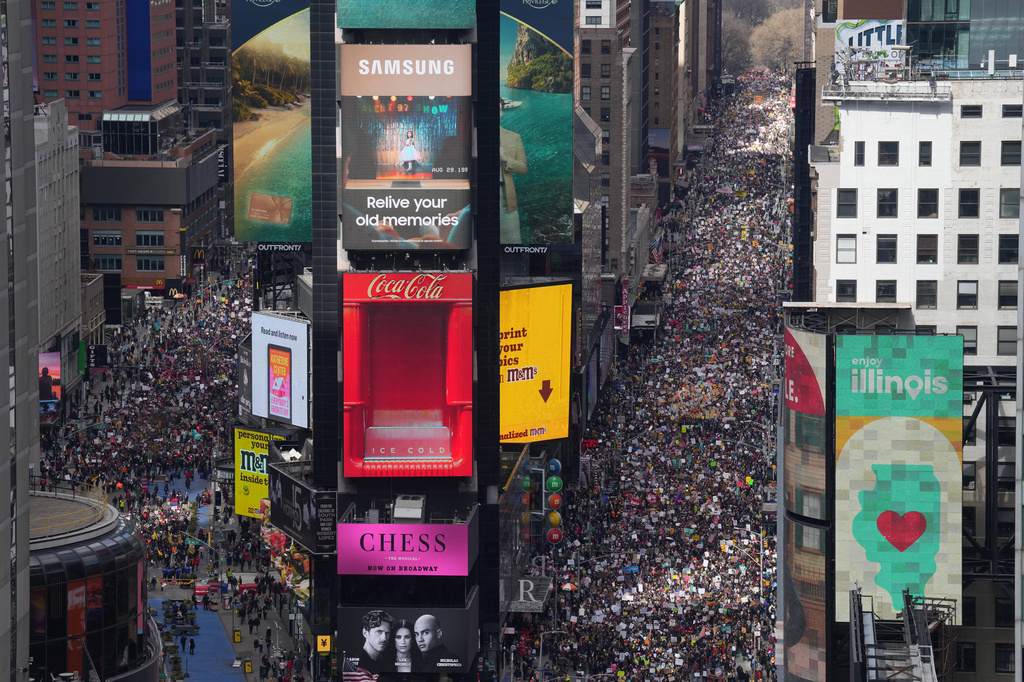
People attend a "No Kings" protest Saturday, March 28, 2026, in New York. (AP Photo/Adam Gray)
You know when you look down a Manhattan avenue and it just goes and goes until it disappears into the horizon? Now imagine the same view, but packed with people instead of cars, and you’d have a good idea of what 7th Avenue looked like during the No Kings protest on Saturday, March 28th. It was the third No Kings protest I’ve attended in New York, and this time, the energy felt different. Last June, I felt a surprised joy that I wasn’t alone in my feelings about my country, and in October, the air was filled with a tentative sense of hope. This time, the crowd vibrated with an anger that wasn’t there before, and a new feeling of empowerment.
In the time between the last day of nationwide No Kings protests and this last weekend, the chaos that is American politics has grown exponentially. ICE has terrorized American cities, murdered American citizens, and committed horrific human rights abuses against countless immigrants whose names, unlike those of Renée Good and Alex Pretti, we will not remember. Many of them are children. The Trump administration has started an illegal war with Iran that is not only creating a global energy and food crisis in the present, but will also make Americans unsafe for decades to come. Every bomb we drop, and every school we blow up, radicalizes a new generation of people who hate America. I can’t blame them; sometimes, I hate America too.
But for all the anger I could sense at the No Kings Protest, there wasn’t really hatred. Most of the signs were humorous, making jokes at President Trump’s expense with pop culture references, puns, and art. Every few blocks I watched people run into their friends, and total strangers would smile and compliment each others’ signs. If people were angrier this time around, it was because of how much America has deteriorated since the last day of national protest. If they were empowered, it was because they were reclaiming their pride in their country. This was especially clear with the number of upside-down flags I saw—for the past several years, the American flag has felt like a symbol of the MAGA movement, but this time, it was just American. It was like we were collectively saying, “What is happening in our country is not what America is supposed to be.” For the first time in a long time, it felt like the resistance was building some momentum.
The feeling of momentum is not unfounded—the June and October protests numbered 5 million and 7 million respectively. According to the organizers behind Saturday’s protest, 8 million people marched, likely making it the single greatest day of nonviolent protest in American history. That’s still not quite enough to tip the scale; political scientist Erica Chenoweth coined what is known as the 3.5% rule, which suggests that a nonviolent political movement needs to sustain engagement from a minimum of 3.5% of the population to be successful at fostering change. The next No Kings day would have to reach around 11 to 12 million people to reach that marker, but that no longer feels out of reach.
Marching in the No Kings protests is empowering not just because engaging in collective action rejuvenates the spirit, but also because the energy of the crowds are so inclusive. No single issue motivates turnout—flags for climate change awareness, antiwar signs, and activist-led union groups coalesced around the single message that America does not tolerate kings, and has not for 250 years. While the past 10 years of American politics have been some of the most divisive of our history, I am more hopeful than ever that we are turning a corner. While we are still struggling to agree with each other about what exactly is wrong with America, more and more Americans agree that the way things are right now just isn’t working. To put it in the words of my generation, the status quo isn’t giving.
While the rising numbers of the No Kings protests are exciting, what really gives me hope is how the openness of the movement inspires an openness among people. For a long time, arguments that the Left should be compassionate towards those who have supported Trump have fallen flat because their endorsement of Trump’s policies communicate support for things that feel unforgivable. That argument rests on the question, do people who have supported unforgivable things deserve compassion? The question that the No Kings protests ask is: How do we go on living with each other after unforgivable things have happened? This framing is forward-thinking, and it’s what gives me hope for my country’s future.

Julia Gubitosi (she/her, they/them) is a second-year master’s student in NYU’s International Relations program. Julia completed a combined BA/MA program in International Peace and Conflict Resolution at American University in 2021, and then worked for a few years in real estate before returning to academia — eventually, Julia plans to pursue a PhD in Political Theory. Julia’s academic interests include gender and feminist theory, political theory, political economy, and nuclear disarmament. When not studying, Julia can be found exploring Central Park while listening to podcasts, reading romance novels, and (attempting) to grow an herb garden.



I like the efforts you have put in this, regards for all the great content.