How the American Cloud Rules Over Europe
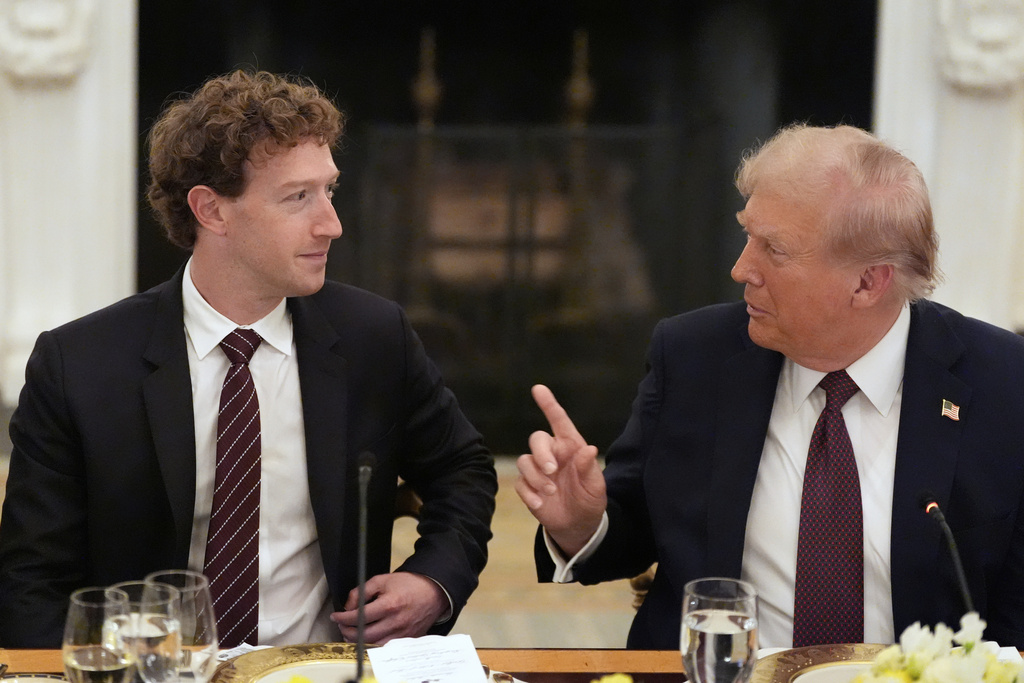
President Donald Trump speaks as Facebook CEO Mark Zuckerberg listens during a dinner in the State Dining Room of the White House, Sept. 4, 2025. (AP Photo/Alex Brandon)
What if, from one day to the next, you were denied access to every essential digital service? You couldn’t message your friend on WhatsApp to meet for lunch, use Google Maps to find the restaurant, or even pay for your meal with your credit card. That is the nightmare that French judge Nicolas Guillou and eight other International Criminal Court (ICC) employees currently live in, as a punishment from the U.S. government for simply doing their jobs. That is the power the White House holds over individuals—and even governments—through American tech giants.
European dependency on American cloud providers and other digital services creates dangerous leverage for the U.S. to enforce its foreign policy agenda. Under the current system, governments risk paralysis, subversion, and loss of sovereignty. The U.S. already demonstrated its willingness to apply political pressure on individuals through companies such as Microsoft, Amazon, and Meta by banning users or withholding services. There is no guarantee that the White House won’t apply the same methods against an entire government. If European governments want to prevent a catastrophe, the transformation needs to start now.
Paralyzing the ICC
The case of Nicolas Guillou represents a terrifying example of what happens when the U.S. decides to blacklist someone. Guillou, a French judge at the International Criminal Court in The Hague, issued an arrest warrant for Israeli Prime Minister Netanyahu and former Minister of Defense Gallant in November 2024, following a year-long investigation. Two months later, President Trump sanctioned the six judges and three prosecutors working on the case. The consequences have been devastating: Guillou was banned from all services provided by American companies, including the global banking system. In practice, this means he cannot use websites or services such as WhatsApp, Amazon, Visa, or PayPal. When he tried to book a hotel in France through Expedia in 2025, the company cancelled his reservation. “The sanctions affect all aspects of my daily life … Being under sanctions is like being sent back to the 1990s,” the judge stated in an interview with Le Monde.

Initially, economic sanctions served as a means for states to address human rights violations in other countries, typically reserved for extremist groups such as ISIS or hostile governments such as Russia and North Korea. Now they are also weaponized to undermine international law. Because of the sanctions, the ICC is facing a growing number of difficulties: the chief prosecutor’s email account has been disabled by Microsoft, multiple employees have quit their jobs out of fear, and other cases are delayed due to the internal turmoil.
U.S. tech companies dominate the European market
Through the sanctions, Guillou discovered a dangerous reality: American companies have a near-monopoly on digital services in Europe. Let’s consider his situation for a moment: despite being a French citizen living in the Netherlands (two countries that do not support the sanctions), the U.S. government was still able to completely upend Guillou’s daily life. The numbers explain why. According to a recent European Parliament report, the EU relies on external countries for over 80% of its digital products, services, infrastructure, and intellectual property – a large share of which is provided by American ‘Big Tech’ companies, such as Google, Microsoft, Meta, and Amazon.
A crucial part of this dependency relates to cloud computing: more than 70% of Europe’s cloud market is controlled by American providers subject to U.S. jurisdiction. This is especially significant considering that more than half of all enterprises within the EU use paid cloud services, and that the majority of European data is stored on U.S. cloud services. When email, office software, file storage, and other core digital infrastructure are managed by parties that are subject to non-European legislation, governments risk the service being turned into political weapons.
What happens if Europe does nothing? The future in this scenario is bleak. If the current trend continues and European reliance on American technology grows, it creates major cybersecurity risks that not only make governments vulnerable to coercion but also expose them to theft of sensitive data and espionage attempts. Considering the trajectory of U.S. foreign policy in the past year, it is not inconceivable that the White House might impose sanctions on one or more European countries to force its hand. If that happens, a company like Microsoft may stop providing services overnight. The effects could paralyze a governmental body: employees would be unable to send emails or make payments, administrative decision-making would be disrupted, and even practical services such as trash collection and public transport could be thrown into disarray. Likely or not, the consequences are too serious to be ignored.
Reducing the dependency
Luckily, European leaders seem to have woken up. Trump’s volatile and erratic behavior has brought European autonomy to the forefront of public debate, with many EU and national policymakers now acknowledging that the dependency is becoming too perilous. In the light of the ICC sanctions, the concept of’ ‘digital autonomy’—the ability to make independent choices about technology without being overly dependent on external parties—has gathered significant attention. But awareness alone isn’t enough. To achieve digital autonomy, European governments need to heavily invest in their own digital infrastructure. Right now, European cloud providers still lack the scale and innovation to compete with their U.S. counterparts, but the power of European public institutions as large-scale customers could help them gain market shares and incentivize other parties to do the same.
This is exactly what the Municipality of Amsterdam has proposed in its recent ‘Digital Autonomy’ strategy. In collaboration with the Dutch government, the municipality has created a detailed ten-year plan to make every crucial digital service autonomous and move all sensitive data to Dutch or European cloud platforms. The plan includes a breakdown of the current digital infrastructure and its vulnerabilities, a list of potential replacement providers, and a proposal to export the same strategy to other municipalities in the Netherlands. In the rest of Europe, we see similar strategies arise, with France, Germany, and the EU’s institutions now slowly moving towards local alternatives.
While this is a very good first step, it’s just a start. “Without sovereignty—military, health, financial and digital—we can no longer guarantee the rule of law,” as the French ICC judge urgently points out. Europe needs to pivot completely if it wants to protect the freedom of citizens such as Nicolas Guillou and uphold the legitimacy of international law, even when both are under attack by the U.S.

Sacha Gyapjas is a second-year MA student in NYU’s International Relations department, focusing on international security and peacebuilding. Originally from Amsterdam, she not only obtained her bachelor’s degree in Liberal Arts and Sciences at Amsterdam University College, but also carries the city’s spirit with her by aspiring to be a determined and compassionate professional in the field of IR. In the past, Sacha has reported on the Dutch creative industry, local news in Amsterdam, and written several pieces on social issues.