Wars Beneath the Waves: The Geopolitics of Undersea Cables
The cables that carry nearly all of the world’s international data sit on the seafloor, barely protected and easily cut–yet most of us have never heard of them, and most governments have treated them as someone else’s problem – until now. The gap between our dependence and our attention is exactly what makes undersea cables so attractive as tools of coercion. As gray-zone tactics spread, great-power competition intensifies, and the AI race drives explosive demand for bandwidth, the seabed is becoming one of the most consequential – and least understood – arenas of geopolitical competition.
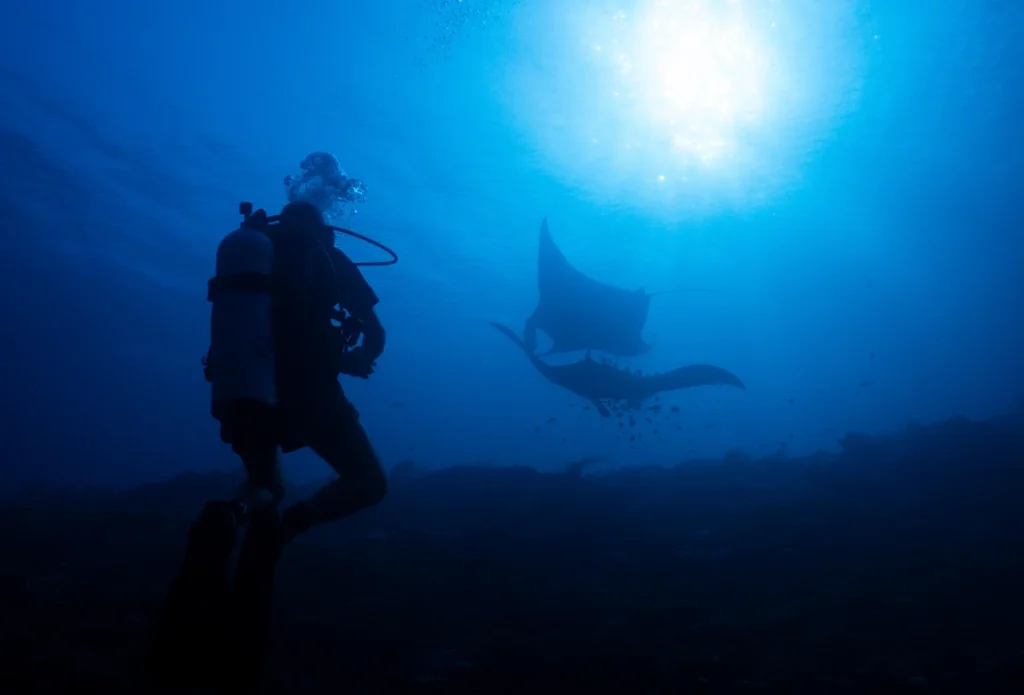
A Scuba Diver Watches Oceanic Mantas at the Manta Ridge Dive Site in Raja Ampat, Indonesia. March 7, 2026. (Claudia Rosel / AP Photo)
In September 2025, multiple undersea cable cuts in the Red Sea knocked cloud services offline, spiking latency, and decreased connection speeds across three continents. Microsoft was forced to warn customers of degraded performance–all before anyone could say who did it or why. The incident exposed a vulnerability that most people never think about: roughly 95 percent of the world’s intercontinental data travels through fiber-optic cables on the ocean floor. When cables break, the damage is immediate, but determining who is responsible takes weeks or months, and repairs depend on a small number of specialized ships and complex international permits. This makes these systems uniquely exploitable. As great-power competition intensifies, global instability and gray-zone tactics proliferate; deliberate or ambiguous disruption of undersea cables is emerging as one of the most consequential and underappreciated risks for the next five years.
Undersea Cables and the Uncomfortable Truth of Interdependence
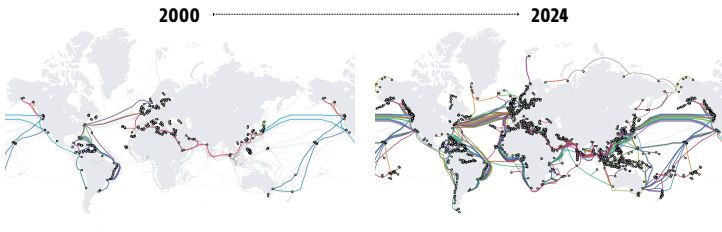
Undersea cables are deceptively modest – about the width of a garden house – yet they carry the infrastructure of modern life. High-speed internet, financial transactions, diplomatic traffic, defense coordination, and cloud computing all ride undersea fiber. When several cables in a single corridor fail simultaneously, redundancy rapidly erodes. Data traffic detours onto longer paths, latency climbs, transaction costs rise, and the effects ripple far beyond the region of the break.
Failing cables are routine– roughly 150 to 200 occur each year, with fishing and anchoring incidents accounting for the vast majority. That ordinariness is precisely what makes the undersea cable infrastructure strategically attractive for malicious interference. It allows deliberate sabotage to hide against a backdrop of plausible accidents. The problem is exacerbated when underwater forensic responses are slow, jurisdiction is fragmented, and repairs depend on a small fleet of specialized ships, spare parts, and increasingly complicated weather windows. A well-timed cut need not be proven deliberate to be useful; the ambiguity itself is a kind of leverage.
Why Cables, Why Now: A Widening Gray Zone
Four converging dynamics explain why the risk of cable interference is heightened more now than ever. First, global dependence on low-latency links and precision timing has deepened to the point where even brief outages cascade into hugely adverse outcomes–a localized incident can extract concessions before investigators even reach the seafloor.
Second, collective governance has not kept pace. Currently, there is no robust international regime to investigate and attribute physical attacks on seabed infrastructure. As such, the longer it takes to assign blame, the more valuable deniable interference becomes for malicious actors.
Third, the tools for disruption have spread. Remotely operated vehicles (ROVs), autonomous underwater vehicles, and deep-sea submersibles are no longer exclusive to a handful of navies, and the states acquiring them are putting them to use. Most submarine cables rest at depths between 1,000 and 5,000 meters, often with little more than a shallow burial or the weight of the cable itself as protection. This makes them reachable by an expanding range of commercial and military underwater platforms. For example, both Russia and China have invested heavily in maritime assets capable of supporting cable interference. In December 2025, a Russian vessel was suspected of deliberately sabotaging a cable connecting Helsinki to Tallinn along the Baltic Sea floor. China, meanwhile, unveiled a ship in 2025 that is capable of severing cable lines at depths of up to 13,123 feet (4,000 meters). Several other states and well-resourced nonstate actors now field comparable capabilities, and instances of alleged sabotage are becoming increasingly frequent. The threat is also not limited to governments. Private companies own and operate much of the world’s undersea cable infrastructure, and as commercial stakes in data routing grow, the possibility of corporate sabotage or coercion – not just state interference – deserves serious attention.
Fourth, as artificial intelligence becomes a defining axis of great-power competition, it is compounding both the stakes and the threat. AI training and usage consume enormous bandwidth. Roughly half of the world’s data-center footprints are located in North America, Western Europe, and the Indo-Pacific, pulling a disproportionate share of traffic through the trans-Atlantic and trans-Pacific corridors, which are already among the most congested. Industry trackers expect subsea cable investment to reach roughly $13 billion between 2025 and 2027, nearly double the previous three-year cycle, reflecting growth in demand and resilience upgrades alike. At the same time, AI lowers the barrier to disruption: models can potentially optimize jamming waveforms, automate target selection along cable routes, and generate deception patterns that compress decision time. While this would help to address the current burden on the cable networks, it could also make malicious probing cheaper, more frequent, and harder to detect.
No Plan B: The Indo-Pacific’s Single Point of Failure

These risks are acutely concentrated in the Indo-Pacific. Long-haul traffic funnels through narrow straits amid intense commercial shipping and escalating US-China strategic friction. As a peninsular state without overland international links, South Korea depends almost entirely on submarine cables for external communications. Japan routes roughly 99 percent of its international data through subsea systems, while India’s $341 billion services-export economy is simultaneously delivered over this same infrastructure. Furthermore, when the 2006 Hengchun earthquakes severed nine cables in the Luzon Strait, Asia-US connectivity slowed for weeks–and that was an accident. More recently, in 2025, Taiwan’s Penghu Islands suffered repeated cable cuts linked to Chinese-flagged vessels, illustrating how contested waters enable a style of coercion that stays just below the threshold of open conflict, or gray-zone pressure. This type of coercion is disruptive enough to cause significant damage, but ambiguous enough that no one can definitively assign blame.
Who Builds the Cables Writes the Rules
The implications also extend well beyond any single region. Undersea cables are the physical infrastructure through which digital globalization occurs. Their vulnerability exposes a fundamental tension at the heart of 21st-century geopolitics: the infrastructure that enables interconnection is also the infrastructure most susceptible to coercion. Additionally, a growing share of new submarine cable systems is funded or co-owned by hyperscale technology firms and authoritarian-state-backed enterprises, meaning that decisions about where cables land, which routes they take, and whose traffic they prioritize are increasingly shaped by both commercial strategy and geopolitical alignment, rather than cooperation. Consequently, whoever builds and controls the cables holds influence over the internet’s topology and, by extension, the digital rules that govern how data flows, where it is stored, and who can access it.
As states compete over AI supply chains and semiconductor access, control over the data corridors that connect these assets may become a source of leverage in its own right. For example, a corridor cut during a potential Taiwan Strait crisis would simultaneously disrupt financial clearing, cloud-dependent logistics, and allied military coordination, forcing governments to make triage decisions with immediate economic and security costs.
Cable geography is quietly reshaping alliance politics: landing-site permits, vendor selection, and repair-ship access are becoming arenas of strategic bargaining. Decisions that once seemed purely commercial now carry geopolitical consequences. The states, coalitions, and corporations that invest in redundancy, pre-position repair capacity, and building credible attribution mechanisms will hold the stronger hand. Those who treat cables as someone else’s problem will find themselves paying the costs when the next ambiguous outage arrives.
What makes undersea cable disruption such a potent concern is the structural mismatch between the speed of fallout from cable damage and the slowness of accountability processes. Disruptions propagate at the speed of data flows; attribution unfolds across jurisdictions, underwater surveys, and diplomatic hedging. Essentially, the world’s dependence on undersea cables has outpaced the attention they receive. The system that connects economies, militaries, and daily life around the world rests on a seabed network of glass threads thinner than a garden hose, lying on the ocean floor with almost no one watching. The seabed is no longer just critical infrastructure – it is strategic terrain, and the competition over who secures it is already underway.

Hana Kim is a second-year MA candidate in International Relations at NYU, concentrating in Asian Studies. She earned her BA in International Studies with an emphasis on Global Politics from Pepperdine University in 2023, where her thesis explored the implications of US censorship on Japan-ROK relations. She has previously interned at the Global America Business Institute, researching international civil nuclear energy policy. Currently, Hana serves as a policy intern at The Korea Society, focusing on US-ROK cooperation and NE Asian affairs. Her interests include East Asian security, alliance diplomacy, and US foreign policy in the Asia-Pacific. After graduating, she plans to pursue a career in foreign policy, advancing resilient US-Asia relations.